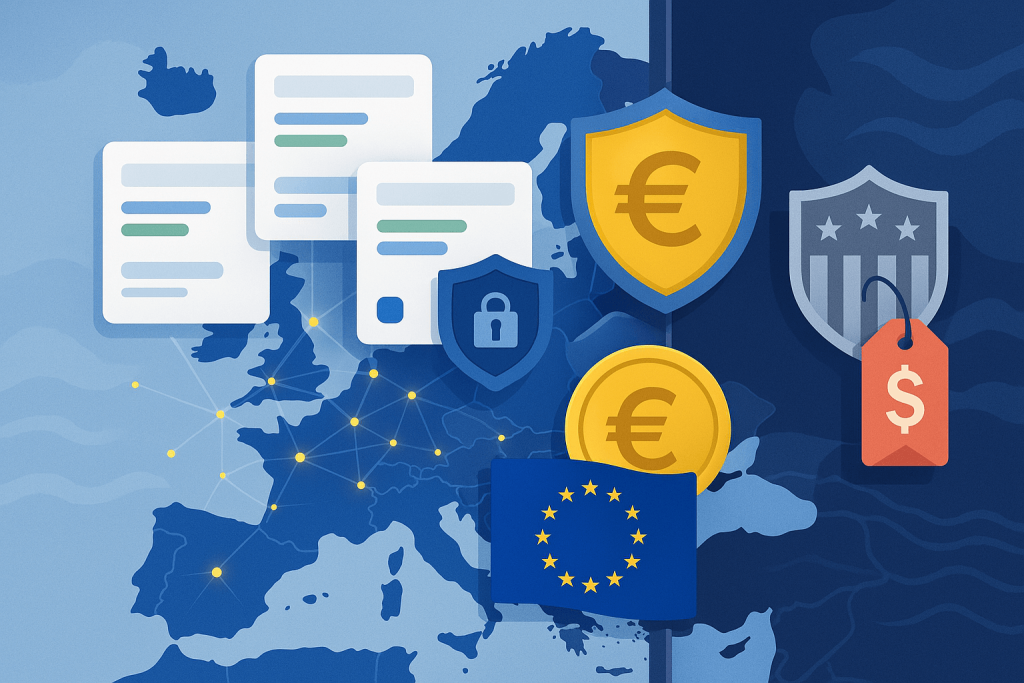
Last spring, our marketing team hit a wall. We’d been using Trello for years, but new data privacy regulations had our legal department asking tough questions about where our project data was being stored. Then came growing concerns about economic and geopolitical tensions between the EU and US, adding strategic considerations to our regulatory ones. I remember our team lead Julia’s face when she realized most of our standard tools were not only hosted outside the EU but also potentially vulnerable to future policy changes. What started as a compliance concern turned into an eye-opening journey through Europe’s vibrant project management software ecosystem.
If you’re facing similar challenges or simply prefer supporting European tech companies, you’re in luck. The EU has developed impressive alternatives to mainstream project management tools like Trello, each with its own unique strengths and European privacy-focused approach.
Why Consider EU-Based Project Management Tools?
When our team began searching for alternatives, we discovered several compelling reasons to consider EU-based solutions:
- Data sovereignty: Your data remains within EU jurisdiction, governed by GDPR protections
- Legal compliance: Simplifies meeting EU-specific regulatory requirements
- Local support: Often provides better timezone alignment and cultural understanding
- Economic impact: Supports European tech innovation and job creation
- Strategic independence: Reducing reliance on US tech companies in an uncertain geopolitical climate
- Long-term stability: Protection from potential future policy or regulatory changes affecting international digital services
Top EU-Based Alternatives to Trello
After months of testing different platforms with our team, here’s what we found about the leading EU-based project management solutions:
Stackfield
Based in Germany, Stackfield stands out as a comprehensive project management solution with robust security features. What impressed us most was its end-to-end encryption – something rarely found in project management tools.
The platform serves over 10,000 companies and has seen impressive growth, with a 70% sales increase in 2022. Their focus on organizations handling sensitive data (government bodies, banks, insurance companies, law firms, and universities) makes them a go-to choice for security-conscious teams.
OpenProject
As an open-source option from Germany, OpenProject delivers a comprehensive platform with flexible viewing options including Kanban boards, timelines, and calendars. When we implemented it for our content team, they particularly appreciated the ability to switch between different views based on their specific tasks.
The platform targets organizations looking to make positive societal impact and data-conscious entities across various industries, with particular popularity in the IT community. Their self-hosting option provides maximum control over data, making it an excellent choice for organizations with strict security requirements.
MeisterTask
Another German offering, MeisterTask has gained substantial traction with over 10,000 companies and 41 million users worldwide. When our design team tested it, they immediately commented on its modern, visually appealing interface.
The platform features intuitive Kanban project boards, task scheduling with calendar integration, built-in time tracking, and robust reporting capabilities. Their free plan is notably generous, offering unlimited tasks and team members.
Zenkit Projects
Zenkit Projects, also from Germany, impressed us with its versatility. When I worked with a cross-functional team last year, we found its customizable interfaces particularly helpful – each department could configure views that worked best for their needs.
The platform offers features such as Kanban boards, Gantt charts, resource planning, and robust file sharing. It’s designed for teams of all sizes seeking an all-in-one collaboration solution.
awork
German-based awork focuses on simplicity without sacrificing functionality. During our trial, our project managers noted how quickly they could onboard new team members – a crucial factor during busy periods.
The platform allows users to create tasks and view them in Kanban boards, timelines, or simple lists. It’s particularly well-suited for creative agencies, consultancies, and IT companies managing multiple projects simultaneously.
Taiga
This open-source tool from Spain offers a refreshing approach to project management. When our development team tested it, they were impressed by how seamlessly it supports both Scrum and Kanban methodologies.
With over 400,000 SaaS users and more than 2 million Docker pulls, Taiga has built a substantial community. Its features include multiple dashboards, Kanban boards, issue tracking, and extensive integration options.
Other Notable EU Options
- Planfix (with EU data centers): Highly customizable management system integrating project management with CRM and other business functions
- AdminProject: Specifically designed for EU-funded projects
- EMDESK: All-in-one platform tailored for Horizon Europe projects
- Kantree: From France, known for customizable cards and flexible views
- Odoo Project: Belgium-based comprehensive business suite including project management
Market Presence and Target Audience Comparison
Understanding who these tools are designed for helps in making the right choice for your specific needs:
| Platform | Estimated Market Presence | Primary Target Audience |
|---|---|---|
| OpenProject | 658+ companies | Organizations with a positive impact focus, data-conscious entities, IT community |
| Zenkit Projects | 28+ companies | Teams seeking all-in-one collaboration, project/product managers, startups |
| MeisterTask | 10,000+ companies, 41M+ users worldwide | Teams of all sizes, medium-sized tech/marketing/design teams |
| awork | 4,000+ teams | Creative agencies, consultancies, IT & software companies (5-500 users) |
| Taiga | 400K+ SaaS users, 2M+ Docker pulls | Cross-functional agile teams, startups, agile developers |
| Planfix | 7,000+ companies, 68,000+ users | Organizations of all sizes, complex multi-level projects |
| AdminProject | Not specified | Project managers of EU-funded projects |
| EMDESK | 1,000+ organizations in EU | Organizations managing EU/national collaborative projects |
| Kantree | Not specified | Teams of all sizes, agencies, HR, marketing, product development |
| Stackfield | 10,000+ companies | Organizations with sensitive data (government, banking, etc.) |
| Odoo Project | 13M+ users globally | Businesses of all sizes, startups, SMBs |
| Trello | Millions of users worldwide | Broad, all sizes and industries, known for simplicity |
The GDPR Advantage
A few months into our search, it became clear that EU-based tools offer a significant edge when it comes to data privacy and security. Working with our compliance team, we realized just how important this factor was becoming for our organization.
EU-based project management tools are particularly attuned to GDPR concerns and often highlight their compliance as key differentiators:
- OpenProject: GDPR compliant by default, stores data within the EU, with self-hosting options
- Zenkit Projects: Stores all user data exclusively in Germany, fully GDPR compliant
- MeisterTask: GDPR compliant and ISO 27001 certified, with servers in Frankfurt, Germany
- awork: Developed and hosted in Germany, GDPR compliant and ISO 27001 certified
- Taiga: Adheres to all French and European data protection laws
- Stackfield: Processes data exclusively on servers in Germany, with end-to-end encryption
In contrast, Trello’s approach requires users to proactively request EU data containment, and even then, it’s owned by an Australian company with data storage occurring outside the EU.
Strengths and Weaknesses: What Users Say
Through our testing and research, we compiled feedback from both our team and wider user reviews:
| Platform | Key Strengths | Key Weaknesses |
|---|---|---|
| OpenProject | Comprehensive features, flexible, open-source, strong data privacy, self-hosting | Steeper learning curve, cluttered interface, no native mobile app |
| Zenkit Projects | Versatile, intuitive interface, good for various team sizes, customizable views | Lack of native mobile apps, some initial complexity |
| MeisterTask | Modern design, built-in time tracking/automation, user-friendly, GDPR compliant | Some features not intuitive, subtasks limited to higher tiers, limited free plan |
| awork | Intuitive control, modern design, smooth workflow, good support, integrated time tracking | Global calendar missing, occasional bugs |
| Taiga | Agile-focused, easy to use, good for Scrum/Kanban, open-source, free self-hosting | Complex self-hosting installation, pricing system changes disliked |
| Planfix | Highly customizable, manages various business functions, suitable for complex projects | Clunky interface, lacks intuitiveness |
| Trello | Simple and intuitive interface, easy to learn, flexible Kanban boards, extensive integrations | Limited built-in features, not ideal for complex projects, data sovereignty concerns |
Making the Switch: Our Experience in an Evolving Digital Landscape
When we finally made the decision to transition from Trello to an EU-based solution, discussions about digital sovereignty were becoming increasingly common in European business circles. What had started as a data privacy initiative had evolved into a strategic business decision. We chose to implement OpenProject for our technical teams and MeisterTask for our marketing department. The process wasn’t without challenges – any platform change involves adjustment periods and training.
Julia, our marketing lead, recalls: “The first two weeks were tough. Everyone was so used to Trello’s workflow that the change felt disruptive. But by the third week, our team was not only comfortable with MeisterTask but discovering features that made our processes more efficient than before. Plus, our leadership team appreciated having more control over our digital infrastructure.”
Our development team found that OpenProject’s open-source nature allowed them to customize elements to fit their specific workflow – something they hadn’t been able to do with Trello. As one senior developer put it, “The current climate between the US and EU made me realize how dependent we’ve become on foreign tech. Having our project management system under European control just makes sense from both a technical and strategic perspective.”
Current Trends in EU Project Management Software
The European project management software market continues to evolve, with several notable trends:
- Digital sovereignty initiatives are gaining momentum as EU businesses seek independence from US tech dominance
- Geopolitical risk mitigation is influencing software procurement decisions
- AI and automation are increasingly integrated to enhance project planning and risk assessment
- Cloud-based solutions remain dominant, offering scalability and accessibility
- Hybrid methodologies combining Agile, Waterfall, and Lean approaches are gaining popularity
- Sustainability and green project management practices are emerging as priorities
- Integration capabilities with other European software solutions
- Multilingual support is increasingly important in the diverse EU market
- Transparent pricing models with regional stability
Choosing the Right EU-Based Alternative
Based on our experience, here are some factors to consider when selecting an EU-based Trello alternative:
- Identify your primary needs: Are you focused on security, customization, specific methodologies, or integration capabilities?
- Consider team size and growth: Some platforms scale better than others
- Evaluate the learning curve: Balance feature richness with ease of adoption
- Test the free versions: Most platforms offer free plans or trials
- Verify data hosting location: Ensure data is stored within the EU
- Check GDPR compliance documentation: Look for specific certifications and security measures
Strategic Considerations in an Uncertain Global Landscape
A growing factor driving EU businesses toward local software solutions is the increasing focus on digital sovereignty and strategic independence. While there are no tariffs on digital services currently, many European organizations are proactively evaluating their software dependencies in light of evolving geopolitical relationships.
“We’re taking a more strategic approach to our software procurement now,” shares Marc, a project director at a mid-sized German manufacturing firm. “It’s not just about features or price anymore, but about where our critical business data lives and who ultimately controls the platforms we rely on daily.”
This perspective is gaining traction. According to recent surveys, nearly 30% of EU businesses are now actively seeking European alternatives to their US software solutions, motivated not just by compliance concerns but by long-term strategic planning and risk management.
Final Thoughts
Switching from Trello to an EU-based project management tool can seem daunting at first, but the benefits – particularly around data sovereignty, GDPR compliance, and strategic independence – make it worthwhile for many organizations.
The EU project management software market offers a rich ecosystem of options to suit various needs, from security-focused solutions like Stackfield to comprehensive platforms like OpenProject and user-friendly alternatives like MeisterTask. As businesses become more conscious of their digital dependencies, these tools represent not just technical solutions but strategic business choices.
Our journey to finding EU-based alternatives opened our eyes to the innovation happening within Europe’s tech sector. What began as a compliance necessity evolved into a strategic approach to our digital infrastructure, ultimately providing us with tools better suited to our specific needs and business environment.
Have you made the switch to an EU-based project management tool? Has the current global climate influenced your software decisions? I’d love to hear about your experience in the comments below.